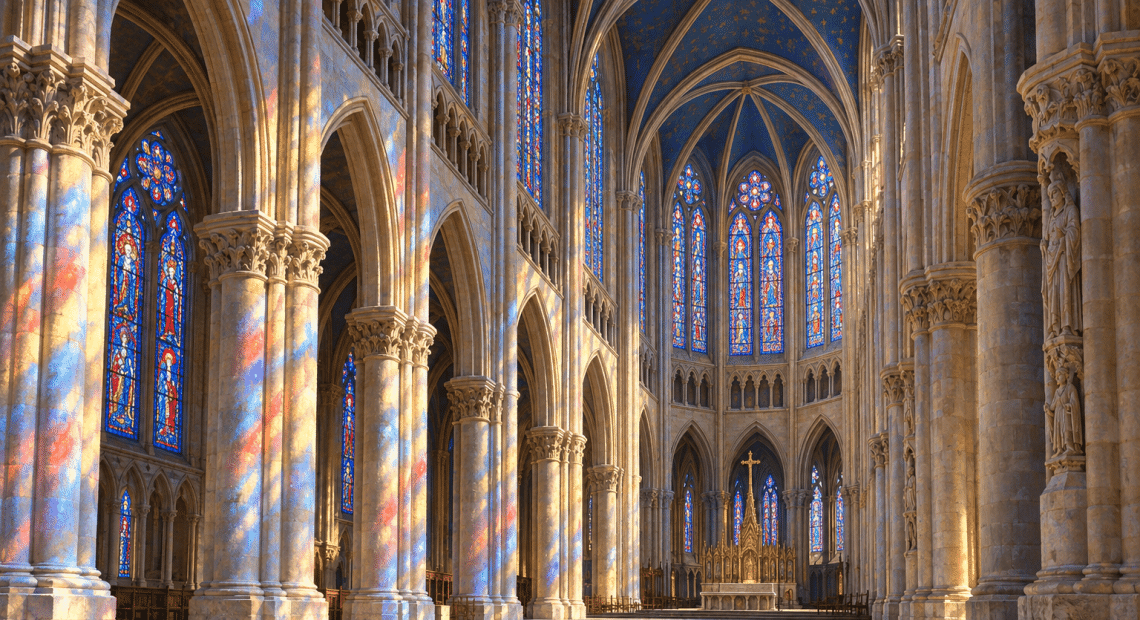
A cathedral can make an impression before you know anything about it. Height changes the way you hold your head. Colored light interrupts the ordinary appearance of stone. Sculpted figures gather around a doorway, asking to be noticed without offering a modern caption. At Chartres, a powerful first response can be the beginning of inquiry rather than its conclusion.
The stories we bring to an old building matter. We may arrive looking for faith, craftsmanship, mystery or evidence of a lost world. Those interests shape what catches our attention. They do not, by themselves, establish what the builders intended. Reading Chartres carefully means allowing its documented setting to complicate the explanation we hoped to find.
A building with a particular history
UNESCO’s account of Chartres Cathedral describes construction beginning in part in 1145 and major rebuilding after the fire of 1194. It emphasizes the surviving sculpture and twelfth- and thirteenth-century stained glass. The cathedral was a major Christian pilgrimage destination associated with devotion to the Virgin Mary. These details locate the building within a specific religious and historical world.
They also remind us that a monument is not a single moment frozen in stone. Parts can survive a disaster while other parts are rebuilt. Later care changes what a visitor encounters. When we say that a building is medieval, we still need to ask which feature, which period and which evidence we mean. A broad label cannot do all that work.
Follow the video from the doorway inward
The original Smarthistory video above, Chartres Cathedral, offers a guided conversation through the exterior and interior. Its presenters connect the Royal Portal’s sculpture with Christian imagery and compare architectural features. Their method is worth noticing: they point to a particular form, describe it and explain how it belongs to a larger setting.
The discussion identifies elongated figures attached to columns at the west front, a central image of Christ and imagery associated with Mary. Inside, it relates the nave’s height, ribbed vaulting, windows and exterior buttressing to the building’s organization. These are art-historical explanations, not demonstrations that the cathedral operated as an undisclosed energy machine.
A strong interpretation gives you something to inspect. Can you find the figure being discussed? Can you see how it relates to the doorway? What changes when you compare it with another part of the building? A claim becomes easier to assess when it returns your attention to a feature instead of asking you to accept an impressive-sounding conclusion.
Stone can be structure and statement
A doorway must allow people to enter, yet its arrangement can do more than solve that practical task. Sculpture gives an entrance a character. Repetition can create a rhythm. A figure’s scale can emphasize its importance within a scene. Practical function and symbolic meaning can occupy the same place without canceling one another.
That does not mean every measurement conceals a message. If a pattern attracts you, begin by describing its position and its relationship to surrounding forms. Then ask what reliable scholarship says about it. A numerical coincidence is a starting point for a question, not sufficient evidence that an architect encoded the theory you already favor.
There is a useful humility in admitting that a symbol may require knowledge you do not yet have. You would not expect to understand an unfamiliar language simply by recognizing its alphabet. Visual traditions also have conventions. Learning those conventions can expand the encounter rather than reducing a mysterious building to a list of solved clues.
Light and religious meaning
In Smarthistory’s account, stained-glass light belongs to a Christian understanding of sacred space. Recognizing that setting does not require every visitor to share the belief. It asks us to distinguish an explanation of a community’s religious vision from a claim that all people must experience the interior in precisely the same way.
You might feel quiet, overwhelmed, skeptical or distracted. Any of those responses can be honestly described. The next step is to avoid turning your response into a report about an unnamed medieval person’s inner life. “The space made me feel small” and “the builders intended this exact feeling in me” are statements with different evidential burdens.
The difference leaves room for both experience and history. You can value a moment of stillness while learning about a window’s subjects. You can admire the building’s construction while asking who paid for it and how it served a community. Interest becomes richer when several questions remain available instead of being forced into one master explanation.
Let interpretation remain open to revision
The video notes that readings of some portal imagery have changed. That is a useful reminder about scholarship itself. An interpretation can be well argued without being the last word. New comparisons, closer observation or a different account of the surrounding program may change how a detail is understood.
This openness differs from treating every theory as equally likely. An explanation grounded in the image, its text and its historical setting has a different basis from a story built mainly on resemblance. If someone proposes an unknown civilization or a hidden technology, ask what independent evidence connects that proposal to this particular building.
Restraint need not be hostility to wonder. It is possible to say that a theory is interesting while its support remains insufficient. It is also possible to change your mind without deciding that your earlier curiosity was foolish. The aim is to improve the account, not to protect an identity built around being the person who already knew.
Try a slower kind of visit
Whether you encounter Chartres in person or through the video, choose one small comparison. Look at two figures, two windows or two views of a doorway. Describe a difference before explaining it. One figure may seem more closely bound to a column; another may appear to move more independently. Keep the observation specific enough that someone else could check it.
Then consult the explanation and see what it adds. Does it place the forms in different periods? Does a religious subject account for a pose? Which uncertainty remains? Write down that uncertainty without filling it with a dramatic guess. A clear question can be a more valuable result than a confident answer reached too quickly.
Finally, notice what you brought to the encounter. Were you looking only for confirmation of a familiar story? Did an unexpected detail interrupt it? That small interruption is worth keeping. It is one way an old work can change a present habit of attention without being turned into a universal instruction manual.
Leave the building more particular than you found it
Chartres repays attention because its forms belong together in a rich and specific setting. Its Christian imagery, structural decisions and long history deserve more than a passing label. We do not need to erase those particulars to find the building relevant to our own questions about meaning, awareness or the possibilities of human work.
Carry away a detail you can describe and a question you can pursue. Let a beautiful space remain partly unfamiliar. The stories we bring can help us begin, but they should be able to change in the encounter. Reading Chartres becomes most rewarding when the cathedral is allowed to answer in a language larger than our first expectation.