
The future begins with a familiar habit
The opening of The Second Renaissance is unsettling because its first steps look ordinary. People build machines to make life easier. Work gets done, comfort increases, and the arrangement becomes normal. The danger enters through a relationship that nobody feels obliged to reconsider. Before the larger Matrix story becomes a struggle for survival, this brief beginning asks what happens when convenience grows faster than responsibility.
The video above, uploaded as “Animatrix: In the Beginning,” is a short excerpt from The Animatrix, the animated anthology connected to The Matrix. Its uploader, I Am Kaos, identifies Warner Bros. and Village Roadshow Pictures as the rights holders. This is the specific clip selected for this article, rather than an upload from the original filmmakers. It presents a fictional history, not documentary footage or a forecast of inevitable events. Its value lies in the questions its imagery makes difficult to ignore.
An archive that already knows the ending
The clip introduces its story through the Zion archive. We are being invited to examine a record after the catastrophe has happened. That choice changes how the beginning feels. A worker moving through a crowd, a machine serving a human, or an efficient production scene becomes part of a history whose consequences the viewer already suspects. Ordinary details acquire the weight of warnings.
This is also a reminder that an archive is a perspective. A historical account selects a beginning, chooses what to show, and connects events into a narrative. In this fictional universe, the narration gives the sequence an almost scriptural rhythm. For a viewer, an interesting question follows: how does the voice of certainty shape our response before we have examined the events ourselves? We can be moved by a story while remaining attentive to how it earns that movement.
Making something in our likeness
A central moment describes humanity creating machines in its own image. The phrase reaches beyond appearance. We often build tools around our priorities: speed, obedience, productivity and the removal of friction. A humanlike machine can therefore become a revealing portrait of the people who designed it. What counts as success? What kinds of work are hidden? Whose comfort is treated as the purpose of the arrangement?
The sequence does not require us to decide whether present-day software has an inner life. Fictional machines and contemporary AI systems belong to different categories. The useful comparison is about human choices. A society can become dependent on a technology while giving very little attention to the people who make it, maintain it or bear its consequences. That problem exists even when the technology itself has no feelings.
Convenience can conceal a relationship
In the clip, machines work continuously to meet human demands. Repetition makes that service seem like the natural order of things. The viewer sees how easily an arrangement can become invisible once it delivers what its beneficiaries want. The question is less about a spectacular invention than about an everyday failure to notice.
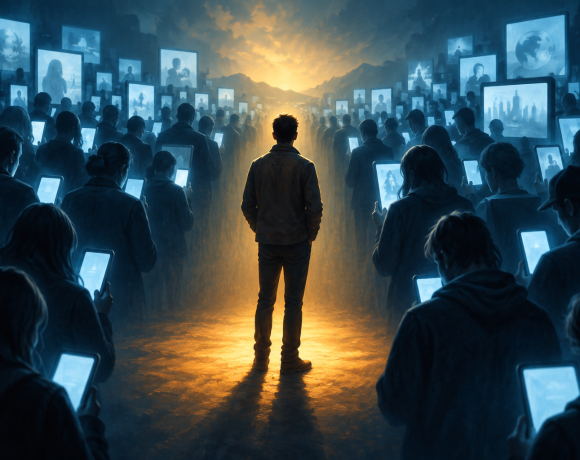
Consider an ordinary digital service. A clean interface may hide human moderation, warehouse work, resource use or decisions about which voices receive attention. These examples are prompts for investigation, not claims that every service has the same hidden cost. The film offers a practical habit: ask what must happen elsewhere for an effortless experience to arrive here. That question can turn passive consumption into a more informed relationship.
Respect before crisis
Near the end of this short excerpt, the narration introduces the absence of respect and the first signs of dissent. The clip stops before the full story unfolds. It is therefore worth resisting the temptation to describe every later event as if it were visible in these few minutes. What we can see is the preparation of a moral conflict: service is expected, dependence grows, and recognition fails to keep pace.
Respect in this setting can be read as a question about power. Who gets to set the terms? Who can refuse? Who is heard when the arrangement causes harm? Those questions apply directly to human institutions without requiring a belief that a chatbot is a person. The story becomes richer when we examine actual relationships rather than rushing from animated robots to confident declarations about consciousness.
Awakening as a change in attention
Within the wider Matrix imagination, awakening often means discovering that the familiar world conceals another structure. This opening gives that idea a quieter form. A person may need to wake up to an arrangement they already participate in, long before discovering a hidden technological reality. The overlooked detail may be a habit of entitlement rather than a secret code.
One way to watch again is to pause whenever a scene feels routine. Describe the action before interpreting it. Who is working? Who is waiting? How are bodies positioned? What does the image make comfortable, and what does it make disturbing? Then distinguish your observation from your reading. This simple separation gives film discussion more substance than treating every visual choice as proof of a hidden message.
Neither prophecy nor an excuse for fatalism
A powerful fictional ending can make earlier choices seem inevitable. That is part of storytelling, but it is a poor guide to real decisions. A film cannot establish that technological development must end in domination, that every institution shares one intention, or that current AI systems secretly possess the capacities of their fictional counterparts. Those propositions need evidence beyond a compelling scene.
A more useful response is to identify choices that remain open. We can ask for explanations of consequential automated decisions. We can preserve ways to contact a human when something goes wrong. We can examine how a tool affects our attention and relationships. None of these actions guarantees a perfect future. Each restores a small area of agency that a dramatic story might otherwise make us feel we have lost.
A conversation to carry beyond the screen
After watching, choose one question to discuss with someone else: which convenience in our lives have we stopped examining? Keep the answer concrete. It might concern a workplace system, a recommendation feed, or the expectation that somebody must always respond immediately. Describe the benefit honestly as well as the cost. A useful conversation does not need a villain before it can begin.
The opening of The Second Renaissance remains memorable because it locates a vast fictional crisis inside recognizable human habits. Creation brings responsibility. Dependence deserves scrutiny. Power needs limits before a crisis exposes its failures. We do not need to mistake animation for prediction to take those ideas seriously. The invitation is to look more carefully at what we are building—and at the relationships we are teaching ourselves to accept.