A small object with a large afterlife
The Cyrus Cylinder is a reminder that an object can outlive the purposes for which it was made. A piece of clay becomes a royal inscription, an archaeological discovery, a museum exhibit and a modern symbol. Each setting invites a different reading. The challenge is to hear those readings without confusing them with one another.
The British Museum’s film A new beginning for the Middle East: The Cyrus Cylinder and Ancient Persia follows this changing significance. It offers an engaging introduction to an object associated with Cyrus’s capture of Babylon in 539 BCE. Watching it closely also opens a larger question: how do we read the words of a powerful ruler, especially when later generations have found reasons to admire them?
Begin with the clay
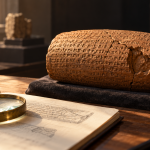
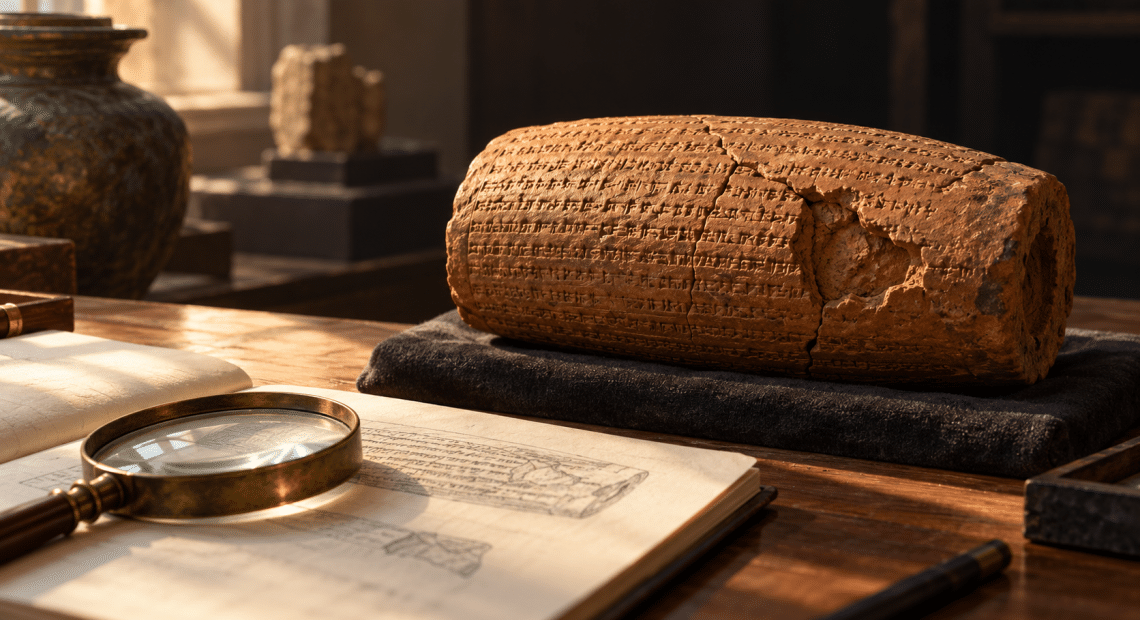
Before interpreting a slogan, notice the physical object. The cylinder is small, barrel shaped and covered with cuneiform. Its material presence asks for a slower kind of attention than a headline. Someone prepared a surface, arranged signs and preserved a message in a form meant to endure. The object carries choices before we have translated a single sentence.
The Metropolitan Museum explains that it belonged to a Mesopotamian tradition of inscriptions placed in building foundations. It was excavated at Babylon in 1879 and survives in joined fragments, with a substantial portion missing. Those details matter because they resist the image of a complete modern document waiting to be read at a desk. We encounter an ancient artifact through recovery, reconstruction, translation and interpretation.
Listen for the speaker
The inscription is a royal account, not an independent witness interviewing every side. In the British Museum’s collection description, Cyrus presents his victory with the support of Babylon’s god Marduk and describes restoration and relief. His message speaks in the language of legitimate kingship. The ruler explains why his rule belongs and why his predecessor’s rule failed.
This does not make the text worthless. Its standpoint is part of the evidence. Ask what the speaker wants an audience to accept, which actions are emphasized, and which people receive a voice. A source can tell us something valuable about political priorities while remaining selective about outcomes. Reading with that distinction is more useful than choosing between total trust and total dismissal.
Restoration and the meaning of return
The museum describes the return of divine images to their sanctuaries, the restoration of temples and the return of some displaced populations. These are significant claims. They concern the repair of relationships between places, communities and religious institutions after conquest. They also help the new ruler present himself as a restorer of order.
Be careful with the step from a particular action to a universal principle. A ruler’s account of restoring selected communities does not by itself establish equal rights for every person under his authority. We can recognize why return and restoration have such emotional force while asking exactly whom the inscription identifies. Its importance grows clearer when its claims remain specific.
What the cylinder does not name
The British Museum’s collection record notes that Jewish people are not mentioned in the cylinder itself, while connecting their return with the broader policy associated with Cyrus. That distinction is easy to lose when an artifact appears alongside a familiar religious story. Related accounts can illuminate one another without becoming identical documents.
When comparing a museum explanation, a translated inscription and a scriptural narrative, keep a separate note for each source. Write what that source actually says before drawing connections. This small discipline protects the interest of the comparison. It makes room for differences in purpose, audience and religious language instead of smoothing them into one seamless account that none of the sources independently provides.
An ancient king and a modern phrase
The cylinder is often called the first charter of human rights. The phrase is powerful because it lets a distant object speak in a language familiar to us. Yet the Metropolitan Museum distinguishes that modern symbolic role from the inscription’s original setting. A text praising a monarch’s rule is a different kind of document from a modern declaration of individual rights.
The difference need not cancel the symbol’s significance. Later generations can draw inspiration from an old object, even while historians describe its earlier purposes more narrowly. The useful question is which kind of claim is being made. Are we describing ancient wording, explaining modern commemoration, or expressing a present aspiration? Those activities deserve to be named separately.
Give the artifact and its reputation separate space
Imagine two pages in a notebook. One records what can be established about the object: material, findspot, language, form and translated content. The other records its later uses: exhibitions, public speeches, commemorations and claims made on its behalf. Neither page is complete, but the separation makes an important relationship visible.
A reputation is itself historical evidence. It tells us what later people wanted from the past. But it cannot be used automatically to fill a gap in the ancient text. If a statement sounds surprisingly like a current political principle, follow it back to an actual translation. Ask whether it appears there, whether it is a paraphrase, or whether someone has supplied a modern interpretation.
Watch with questions that can change
The film is a starting point for inquiry rather than the last word on an empire. Pause after one substantial claim and ask what would help you understand it better. You might compare a museum catalogue with a translation, look at how a fragment was identified, or investigate why a particular modern audience adopted the object as a symbol.
Let your first question remain revisable. You may begin by wondering whether Cyrus was an unusually generous ruler and discover a more precise interest in royal language or museum storytelling. That is progress. A question does not fail when it becomes narrower. Often it becomes answerable, and the answer becomes more interesting because it no longer has to explain everything at once.
The quiet work of historical attention
Lost history does not always require a hidden chamber or a suppressed revelation. Sometimes it begins with an object that is famous enough to seem already understood. The familiar label sits in front of the evidence, and our attention stops there. Looking again means asking what that label leaves out.
The Cyrus Cylinder rewards this second look. It brings conquest, restoration, religious language and later memory into the same field of view. We do not have to turn its ruler into either a flawless hero or a single convenient villain. We can study the claims, notice the purposes they served, and remain interested in the people whose experiences the inscription cannot fully recover.
Leave room for the next reading
Return to the clay at the end of the film. Its survival is remarkable, but survival has not made it a complete account of the world that produced it. What it gives us is a message with a standpoint, carried across time through material, language and interpretation.
That is enough to begin a serious conversation. Read the inscription, compare the explanations, and ask who is speaking at each stage. The past becomes richer when we allow it to retain its differences from the present. An ancient object can still matter deeply without being made to say everything we hope to hear.