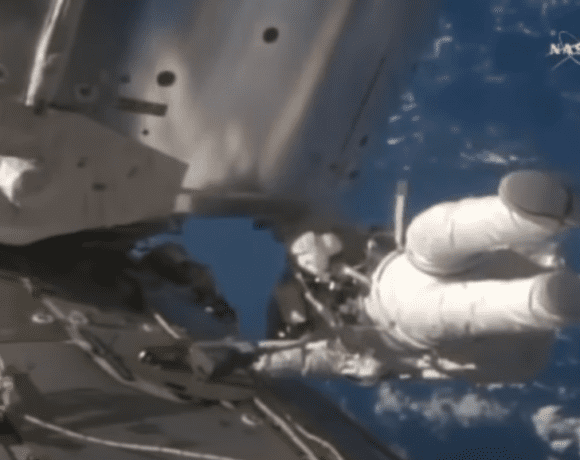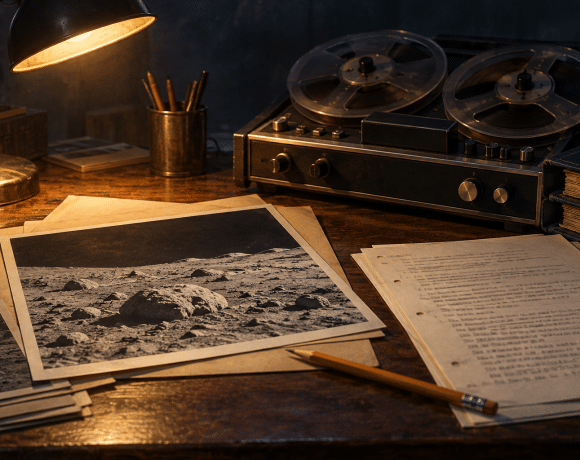
A JRE Clips video titled “Bart Sibrel Argues That The Moon Landing Was Staged” brings a provocative allegation into focus: that the Apollo landings were a production rather than an achievement in spaceflight. [1] The allegation deserves a clear distinction from the evidence. Documented observations support the conclusion that astronauts landed on the Moon. A persuasive challenge would have to explain that record, not simply make the familiar story feel less comfortable.
For readers drawn to questions about hidden history and institutional power, Apollo offers a useful test of discernment. Questioning authority can uncover errors. It can also become a habit of accepting any alternative that opposes authority. The more demanding approach applies the same scrutiny to both accounts, asks what would change our minds, and follows the strongest available evidence.
Start with a claim that can be tested
The supplied clip’s title establishes the topic of the allegation. It does not establish that the allegation is true, and this article does not attribute specific spoken arguments to Sibrel without a verified transcript. The broader question can still be examined: does the publicly available record fit actual lunar missions better than a staged production?
A claim that every Apollo landing was fabricated is much larger than a claim that a particular photograph looks unusual. It must account for evidence produced at different times, by different instruments and institutions. That includes material returned to Earth, radio observations, equipment identified at landing sites, and experiments using hardware on the lunar surface. Each has limitations; together they create a demanding test for an alternative explanation.
The evidence extends beyond television
NASA’s Apollo Lunar Collection records 382 kilograms of rocks, core samples, pebbles, sand, and dust collected by twelve astronauts. Its public Astromaterials 3D resource allows readers to explore selected specimens. [2] These objects give researchers something more substantial to investigate than a televised image or an astronaut’s recollection.
The collection spans six surface missions conducted between 1969 and 1972. [2] That scope matters: a claim about the program concerns repeated expeditions, distinct landing sites, and multiple sample collections, rather than a single televised event.
The samples also remain scientifically useful. NASA describes research using Apollo material to investigate the Moon’s early evolution, more than fifty years after collection. [3] That continued analysis matters because the collection can be examined with methods developed long after the missions ended.
Lunar material alone does not establish human collection in every conceivable scenario. Robotic missions can also return samples. The relevant question is whether a proposed alternative explains the documented collection and its context. Simply suggesting that another method is imaginable leaves the work of demonstrating that method undone.
An observatory recorded the descent
Evidence outside NASA deserves particular attention. The University of Manchester’s Jodrell Bank Centre for Astrophysics publishes a chart recording of signals it received from Apollo 11’s Eagle lander. Its explanation identifies frequency changes associated with the craft’s motion, followed by the signal pattern after landing. [4]
The underlying principle is the Doppler effect: relative motion changes the frequency received by an observer. Jodrell Bank explains that part of the early trace reflects receiver adjustments, while later variations correspond to the descent. That detail is important. A responsible reading distinguishes an instrument’s behavior from the event being measured.
This is a contemporaneous observational record held by a British university, rather than another repetition of NASA’s announcement. It does not independently verify every detail of the mission. It does provide evidence that a comprehensive staging theory must address, including the source and behavior of signals received from the lander.
What later spacecraft observed
NASA’s Lunar Reconnaissance Orbiter subsequently photographed the Apollo 11 landing site. The agency identifies the descent stage left on the surface and trails made by the astronauts’ footprints. [5] These are orbital observations of the site decades after the mission, not enlargements of the original television broadcast.
They should be described accurately. Seeing a trail from orbit is different from resolving the tread pattern of an individual bootprint. Likewise, a labeled image should be evaluated through its source, resolution, and acquisition context rather than treated as self-explanatory.
Japan’s Kaguya mission provides another comparison. JAXA reported a probable brightened area associated with the Apollo 15 lander’s engine exhaust. Its mission FAQ explicitly states that the terrain camera’s ten-meter resolution could not clearly resolve objects as small as the lander and rover. [6] That limitation strengthens the description’s precision: the observation concerns a surface feature consistent with the landing, not a close-up photograph of an astronaut or vehicle.
Reflectors still support measurement
Lunar laser ranging adds an experimental connection between Earth and the Moon. Researchers send light toward retroreflector arrays and measure the return time to calculate distance. A research paper describing fifteen years of measurements from the Apache Point Observatory Lunar Laser-ranging Operation reports observations involving five lunar arrays. [7]
The International Laser Ranging Service documents arrays associated with Apollo missions and with Soviet Lunokhod robotic missions. [8] This distinction prevents a common overstatement. A reflector on the Moon establishes the presence of useful hardware; by itself, it cannot demonstrate that a person placed it there, because robotic spacecraft have carried reflectors too.
Its evidential value comes from the wider record. The Apollo arrays occupy documented sites and support measurements that other researchers can study. A serious alternative account must explain that hardware alongside the tracking, samples, and surface observations, rather than dismissing each category in isolation.
Radiation was a hazard with measurable exposure
Another question worth examining is whether the radiation environment made lunar travel impossible. NASA’s Apollo Lunar Surface Journal includes a radiation review drawing on dosimeter readings and the program’s biomedical reporting. It records different accumulated doses across the missions and notes that no major solar energetic particle event occurred during them. [9]
The same review discusses a dangerous solar event in August 1972, between Apollo 16 and Apollo 17. This is an important qualification: completing the missions did not mean space radiation was harmless. Conditions and exposure mattered, and an unfavorable event could have threatened a crew.
An argument about radiation therefore needs to address the measured doses and mission circumstances. The existence of a hazardous region does not, without that analysis, establish that every passage through it must be fatal. Equally, a successful short mission cannot establish that much longer exposure is safe.
Keeping inquiry open without abandoning standards
A useful investigation gives people a route to check its conclusions. Open the observatory record. Read the imaging limitations. Notice what the laser experiments establish and what they cannot establish alone. Keep a distinction between an unanswered personal question and a contradiction in the historical evidence.
The evidence considered here supports the reality of the Apollo lunar landings. A different conclusion would require a coherent account that explains these observations better, backed by evidence that can itself be scrutinized. Suspicion can motivate that work, but it cannot substitute for it.
For Awakening365 readers, the worthwhile invitation is to practice that standard consistently. We can remain curious about institutional narratives while refusing to turn uncertainty into certainty about a conspiracy. The same openness that permits a challenging question should permit an answer that confirms a remarkable human achievement.